Here are some rules to remember when writing:
1. Don't use no double negatives.
2. About them sentence fragments and pronouns.
3. Verbs has to agree with their subjects.
4. Correct spelling is esential.
5. When dangling your participles are in the wrong place.
6. Use your apostrophe's correctly.
7. Don't use commas, that aren't necessary.
8. Proofread you writing.
9. i think case is important.
Remember, you must first know the rules before you can break them!
Showing posts with label writing. Show all posts
Showing posts with label writing. Show all posts
Tuesday, November 16, 2010

Tuesday, November 9, 2010
Writing -- A Few Simple Rules
Have you ever noticed that, while your writing teacher corrects your punctuation and your tenses, famous authors use them in novels all the time? If you pay attention, though, those novels are sometimes written from a certain character's point of view, that is, the character is telling the story. Other times, the author only breaks the grammatical rules when he is writing one character's dialog. In these cases, the author is using grammar to reveal details about a character.
Make no mistake. These authors know how to use perfect grammar, but they choose to break the rules in order to let us infer more about a character. You must know the rules before you break them!
Here are some examples of how you can have fun with the rules of grammar:
1. Always avoid alliteration.
2. Prepositions are not words to end sentences with.
3. Avoid cliches like the plague.
4. Employ the vernacular.
5. Eschew ampersands & abbreviations, etc.

6. Parenthetical remarks (however relevant) are unnecessary.
7. It is wrong to ever split an infinitive.
8. Contractions aren't necessary.
9. Foreign words and phrase are not apropos.
10. One should never generalize.
11. Eliminate quotations. As Ralph Waldo Emerson once said, "I hate quotations. Tell me what you know."
12. Don't be redundant. Don't use words more than necessary. It's highly superfluous.
13. Comparisons are as bad as cliches.
14. Be more or less specific.
15. Understatement is always spectacular.
16. Exaggeration is a billion times worse than understatement.
17. One-word sentences? Elliminate.
18. Analogies are like feathers on a snake.
19. The passive voice is to be avoided.
20. Who needs rhetorical questions?
Tuesday, November 2, 2010
Writing - The English Language is Difficult!

Did you know that the English language is one of the most difficult languages to learn to read and write? The reason is that, although we have rules, we also have many, many exceptions to those rules. We also have tons of homophones, or words that sound the same, but are spelled differently or that have different meanings. And then there are homonyms, or words that are spelled the same, but have different meanings.
Keep in mind that because our language is so crazy, we are able to have a lot of fun with it!
The bandage was wound around the wound.
The farm was used to produce produce.
The dump was so full that it had to refuse more refuse.
We must polish the Polish furniture.
He could lead if he would get the lead out.
The soldier decided to desert his dessert in the desert.
A bass was painted on the head of the bass drum.
When shot at, the dove dove into the bushes.
I did not object to the object.
The insurance was invalid for the invalid.
Since there is no time like the present, it is time to present the present.
There was a row among the oarsmen about how to row.
They were too close to the door to close it.
The buck does funny things when the does are present.
A seamstress and a sewer fell down into a sewer line.
To help with the planting, the farmer taught his sow to sow.
The wind was too strong to wind the sail.
After a number of injections, my jaw got number.
Upon seeing the tear in the painting, I shed a tear.
I had to subject the subject to a series of tests.
How can I intimate this to my most intimate friend?
Tuesday, October 19, 2010
Tip of the Week - Compare and Contrast
You may be asked to write an essay that compares and contrasts two things or ideas. Remember this:
Compare = Similarities
Contrast = Differences
When you are asked to write a "compare & contrast" essay, you should discuss the ways in which two things are th e same and different. The easiest way to organize your ideas for this type of essay is by using a Venn Diagram. Just make two overlapping circles. Label each circle with one of the things you're comparing and contrasting. For example, in this diagram, we're comparing and contrasting dogs and cats. In the "dog" circle, we've listed some ways that dogs are different from cats; in the "cat" circle, we've listed some ways that cats are different from dogs. In the place where the two circles overlap, we've listed some things that apply to both dogs and cats.
 e same and different. The easiest way to organize your ideas for this type of essay is by using a Venn Diagram. Just make two overlapping circles. Label each circle with one of the things you're comparing and contrasting. For example, in this diagram, we're comparing and contrasting dogs and cats. In the "dog" circle, we've listed some ways that dogs are different from cats; in the "cat" circle, we've listed some ways that cats are different from dogs. In the place where the two circles overlap, we've listed some things that apply to both dogs and cats.
 Now we have our ideas all set up for three paragraphs for the body of our essay. In one paragraph, we'll talk about dogs. In the next paragraph, we'll talk about cats. In the third paragraph, we'll talk about both of them. Of course, we'll still need opening and closing paragraphs, too! Use this Venn diagram to practice writing a "compare & contrast" essay, or make one of your own!
Tuesday, September 28, 2010
Tip of the Week -- Singular and Plural Possessives
Last week, we talked about apostrophes in contractions and possessives. This week I wanted to take a closer look at possessives. Possessive apostrophes can be confusing, but we'll try to make it clear.
Singulars are easy! Just add "apostrophe s". For example, Jim's car.
But what if Jim uses his real name, James? Is it James' car? James's car? James car? Well, James is one person, so he's singular. Use the same rule! James's car is correct.

Now let's look a plural example. The Smiths live next door. Notice that we just add an s to show that there is more than one Smith living next door. If they have a cat, we would say the Smiths' cat. The apostrophe after the s shows that Smith is plural, that is, a number of Smiths own the cat. If Mrs. Smith lives alone and has a cat, it would be Mrs. Smith's cat.
Here's an easy way to remember: If there is one Smith (singular), then the singular word Smith appears before the apostrophe. If there is more than one Smith (plural), then the plural word Smiths comes before the apostrophe.
Let's look at one more example. What if the James family lives next door? We say, "The Jameses live next door. If Mr. James (singular) has a truck, we would say Mr. James's truck. If the James family (plural) has a dog, we would say the Jameses' dog.
Tuesday, September 21, 2010
September 21, 1866

Science fiction pioneer HG Wells was born today in 1866. Wells wrote such classics as The Time Machine, The Invisible Man, and War of the Worlds, all of which later became classic films as well.
On October 30, 1938, Orson Welles directed an narrated War of the Worlds as a radio play on the Columbia Broadcast System (CBS). The play was presented as a series of "news bulletins" and without commericial interruptions. It was intended as a spooky Halloween show. Unfortunately, many Americans had missed the beginning of the show and did not realize that it was a Halloween prank. This resulted in mass hysteria across America by people who believed that space aliens were invading the planet.
Writing Tip of the Day - Apostrophes

Have you ever seen a sign like this at a store or along a road:
Did you notice that unnecessary apostrophe? This is called a "grocer's apostrophe" because it is commonly seen in grocery stores and roadside produce stands, although it could pop up anywhere.
Apostrophes can indicate two things - either that two words are being combined into one contraction or that something is owned by someone or something else.
Let's take a look at the first case - the contraction. A contraction happens when two words are combined into one. The apostrophe substitutes for the missing letters.
For example:


Now let's look at the second case - the possessive. The possessive form is used to indicate that something belongs to someone or something else. In this case, we add "apostrophe s" to the end of the name of the person or the thing that does the possessing.
For example:
This is Sarah's puppy. The yellow toy is the puppy's rubber ducky.
Tuesday, September 14, 2010
Writing Tip of the Day -- Conjunctions
A conjunction is a connecting word. It connects two thoughts. The easy way to remember the conjunctions is to remember FANBOYS.
For (when it means "because")
And
Nor
But
Or
Yet
So (when it means "as a result")
For (when it means "because")
And
Nor
But
Or
Yet
So (when it means "as a result")
Tuesday, September 7, 2010
Writing Tip of the Week: Run-On Sentences

A run-on sentence doesn't know when to stop. It goes on and on, combining two or more ideas with no, or incorrect punctuation.
For example: I had pizza for lunch it was good. This type of run-on is called a fused sentence because there are two complete thoughts here, but no punctuation.
The easiest way to correct this run-on is to add a period and separate the two thoughts into individual sentences: I had pizza for lunch. It was good.
We could also fix it with a comma that separates the thoughts, but does not create a separate sentence. If we do this, we must also use a conjunction, or connecting word. For example, I had pizza for lunch, and it was good.
Remember that 1 comma + 1 conjunction= one period.
Tuesday, August 31, 2010
Writing Tip of the Week -- Organized Writing
Essays are like sandwiches. The main idea is the meat; there should be a little bit in every bite. The supporting ideas are like condiments; they should spice up the essay without overpowering the main idea. The opening and closing paragraphs are the two slices of bread that hold it all together.
Paragraphs are like mini-essays. Again, the main idea is the meat. The supporting details are condiments, and the topic sentences and conclusions are the bread.
Take a look at this opening paragraph:

Paragraphs are like mini-essays. Again, the main idea is the meat. The supporting details are condiments, and the topic sentences and conclusions are the bread.
Take a look at this opening paragraph:
Tuesday, August 24, 2010
Writing Tip of the Week -- Journaling

Whether you are learning a new skill or just sharpening the skills you have, practice is important.
A good way to practice writing is to keep a journal. Some people carry a notebook with them and when they have a few minutes, they write. Some people prefer to write for long periods at a time, when they wake up or just before they fall asleep.
A journal can be as plain or as fancy as you want it to be. It's yours, so you can make it any way you like. You can also write about anything you want. It's yours, and only yours. You never have to share it with anyone.
The purpose of journaling is to get your thoughts on paper. It's not about spelling, grammar, or punctuation. Rather than just listing what you did today, write about the places you've been and the people you've met, and most importantly, what you think and how you feel about them. Write about yourself and the decisions you've made, or that you will need to make in the future. Write about your childhood and how it has affected you as an adult. Because you never have to share it, allow yourself to be completely honest. And don't think too hard -- just write!
Tuesday, August 17, 2010
Writing Tip of the Week - Subject-Verb Agreement

If you have a hard time remembering how to make your subjects and verbs get along with each other, this chart might be useful.
There are 6 types of subjects. Let's look at them.
The left column on the chart shows the singular subects and the column on the right shows the plural subjects.
The rows show first person, second person and third person points-of-view.
Every subject has two parts: point-of-view and singular/plural. For example, the word "I" is first person singular, while the word "they" is third person plural.
Let's take a closer look at the word "you." It's both singular and plural. For example, if I'm talking to one friend, I might say, "You are my friend." If I'm talking to two or more friends, I would still say, "You are my friends."
There are many slang ways to differentiate between the singular and plural "you." In the South, they say "you all" or "y'all." In New York, they say "yous." We Pennsylvanians usually say "you'uns or "y'uns," depending on which said of the state you live! Those are all forms of slang. You should avoid slang when writing, and use "you" whether your subject is singular or plural.

I've conjugated the regular verb "walk" on this chart so that you can see the different forms. Note how they change depending on the subject.

On this chart, I've conjugated the irregular verb "to be." Part of what makes this verb irregular none of the present tense (happening right now) forms of the verb is "be." Again, note how the verb changes with the subject.
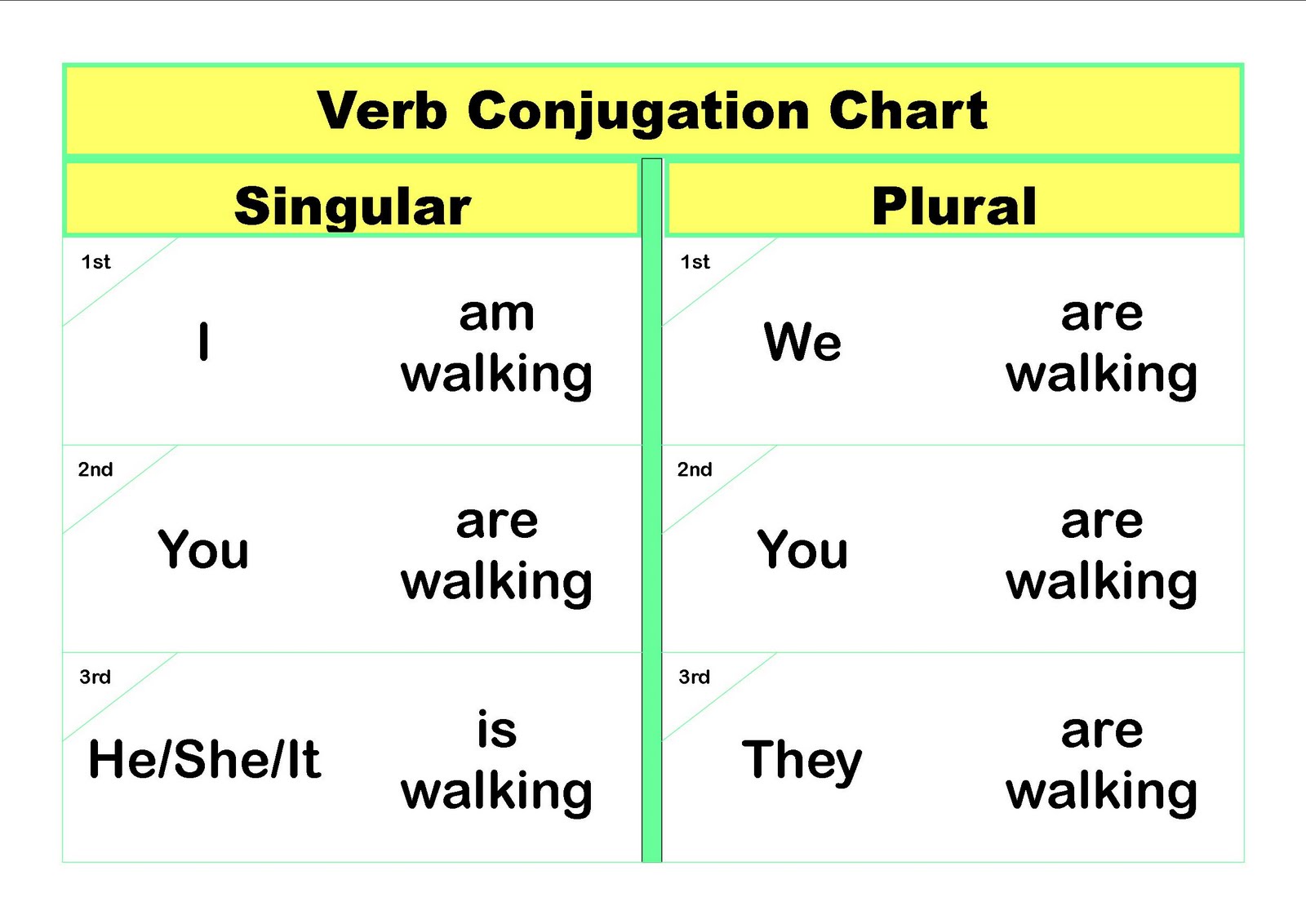
And on this chart, I've combined the two verbs to create the infinitive verb "to be walking," so you can see how the verb changes again. The infinitive form just means "a state of being," and usually involves the verb "to be" in one of it's many forms.
Tuesday, August 10, 2010
Writing Tip of the Week

Did you know that commas can save lives? There is a world of difference between these two sentences:
1. Let's eat, Grandpa!
The comma in the first sentence indicates that you are speaking to Grandpa.
 .
.2. Let's eat Grandpa!
The lack of a comma in the second sentence indicates that Grandpa is the direct object and the eating will be done to Grandpa.
Subscribe to:
Posts (Atom)